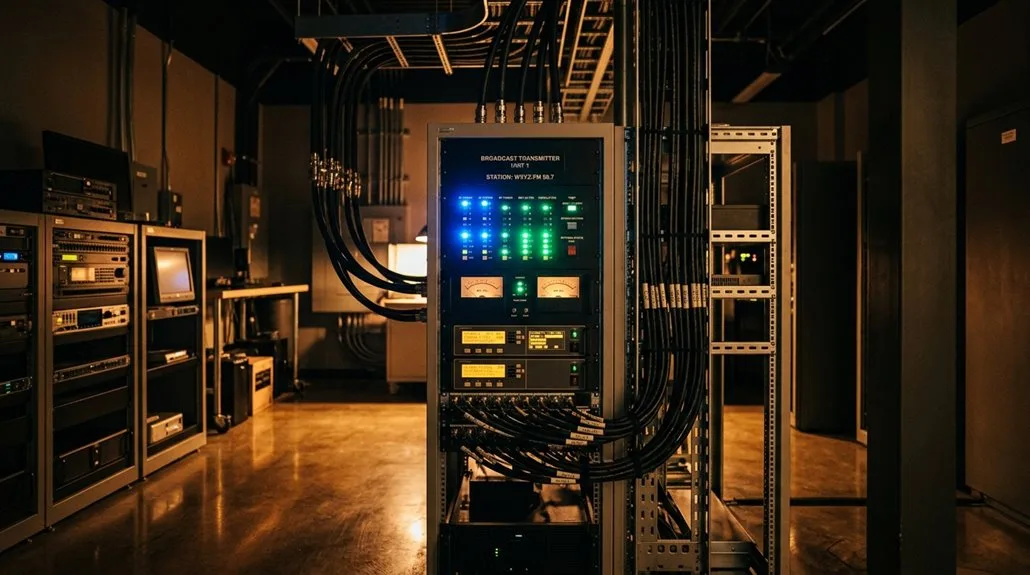
Most radio stations are haemorrhaging nearly half their signal strength before a single listener even tunes in—and they have no idea it’s happening. In 2026, mismatched antennas and poor transmitter decisions are quietly killing broadcasts that should dominate the dial. Every cable, connector, and frequency choice either builds your signal or buries it. This guide breaks down every critical decision standing between a weak transmission and a station that actually reaches people.
How to Choose the Right FM Frequency for Your Radio Station
Picking the right FM frequency sets the foundation for your entire radio station operation. The standard FM broadcast band runs from 87.5 to 108.0 MHz globally. Your region may restrict usable slots to 88.1–107.9 MHz.
Selecting the right FM frequency is the first critical step in building a successful radio station.
Your community of radio broadcasters benefits when everyone avoids interference. Use band analysers and vacant frequency tools to identify unused slots in your area. Enter your city or postcode to find available options.
Follow these key selection principles:
- Choose odd frequencies like 95.5 MHz for better tuner compatibility
- Avoid strong local stations to prevent signal overlap
- Stay within 72 kHz modulation limits to maintain your licence
FM Transmitter Equipment Every Station Needs
Setting up your FM radio station starts with assembling the right equipment. Every station in the broadcasting community relies on the same core components.
You’ll need these essentials:
- Transmitter: The FMUSER 3000W FM Stereo Transmitter covers 87.0MHz to 108.0MHz with ±200Hz carrier frequency precision.
- Antenna: A 4-bay Dipole Panel Antenna with VSWR <1.1 maximises signal coverage.
- Mixing Console: A 16-channel digital mixer handles routing and processing.
- Audio Processor: The Mirage 4 Evo DSP enhances your signal quality.
- Automation System: The DJ-AUTO-200 enables 24/7 broadcasting.
- Monitoring Equipment: Headphone amplifiers and studio monitors guarantee accurate sound.
Your station joins a great community of professional broadcasters when you invest in proper infrastructure from the start. Connecting your transmitter to the tower requires thick rigid coaxial cable designed specifically for RF energy transmission at broadcast power levels. All radio packages should include CAP emergency alerting to keep your station compliant and your listeners informed during critical events.
How to Wire Power, RF Cables, and Connectors Without Signal Loss
Once you’ve assembled your broadcast equipment, the next step is wiring everything correctly. Poor wiring introduces signal loss, hum, and interference. These problems reduce your transmission range and frustrate listeners.
Wiring done wrong kills your signal before it ever reaches a listener. Get it right from the start.
Follow these four wiring essentials:
- Use RG-213 coaxial cable for high-power transmitters, as it delivers lower signal loss
- Choose PL259 or N-Type connectors, which handle FM broadcast frequencies safely
- Keep power and signal cables physically separated to prevent electromagnetic interference
- Use a stabilised 12–15V, 2A minimum power supply for low-power transmitters
Cable length increases signal loss. Shorter runs with quality cables produce great results.
Secure cables with clips and loose cable ties to protect internal conductors. Inspect your cables and connectors regularly, as corrosion and physical damage can degrade signal quality over time. Proper installation means you’re building a reliable station that performs consistently alongside other serious broadcasters. For large facilities requiring signal transmission across long distances, tactical fibre optic cable provides high-definition signal integrity that standard coaxial runs cannot match.
How to Install and Position Your FM Antenna for Maximum Coverage
Your antenna’s position determines everything about your station’s coverage. Mount it at least 20 metres above ground to maximise line-of-sight signal propagation. Higher elevation extends your transmission horizon considerably.
Choose a location with full 360-degree visibility. Keep it clear of trees, buildings, metal poles, and other antennas. These obstacles weaken your station’s signal before it reaches listeners.
Install your antenna vertically for correct functioning and maximum output. Use a bare metal mounting surface without paint or powder coating to assure proper grounding. Always orient dipole antennas perpendicular to the signal source. For large-scale commercial deployments, coordinating antenna infrastructure early with electrical contractors during construction ensures structural supports and cabling routes are calculated before ceiling or roof closures are completed.
Elevated external antennas can extend your station’s coverage up to 30 kilometres across terrain. That’s a great result for community and regional broadcasters building reliable infrastructure from the ground up. Keep your antenna cable away from power cables, ignition cables, and engine electronics to prevent radio interference noise.
Scaling Your FM Transmitter Setup From Low-Power to High-Watt
Most FM transmitter setups begin small and scale upward as your station’s coverage needs grow.
Low-power configurations start at 6V DC, producing roughly 5mW, then scale to 200mW at 13.8V.
You’ll feel part of a growing broadcast community as your signal reaches further.
Scaling milestones every station builder should know:
- Low-power: 180–200mW output at 13.8V supply
- Medium-power: 4–5 watts at 15V after trimmer adjustments
- High-power amplifiers: amplify output from 0.5W up to 3+ watts at 15V
- National coverage: requires hundreds of kilowatts with advanced cooling systems
Your audio mixing console connects cleanly into each power stage.
Keep audio levels controlled to prevent overdeviation.
Each scaling step delivers a great result when tuned correctly.
At higher power levels, always install a Cauer-Chebyshev elliptic LPF between your transmitter and antenna to achieve approximately 20dB attenuation at 118.8MHz and protect the aircraft communications band.
For complex installations involving transmission towers and elevated structures, professional antenna installation ensures structural safety and optimal signal propagation at every power level.