Branded content for TV isn’t what most producers think it is anymore. By 2026, the guesswork is gone—measurement tools now confirm exactly what moves audiences across linear and streaming, and the gap between forgettable programming and content viewers genuinely trust comes down to specific production decisions. Studio setup, data targeting, audience distribution—every layer matters more than it did five years ago. What separates the campaigns that land from the ones that disappear after one airing is covered in full here.
What Is Branded Content Production for Television in 2026?
Branded content production for television creates programming that’s funded by advertisers to reflect brand values rather than sell products directly. It’s storytelling built around brand identity, lifestyle, and values. You’ll see it in documentaries, short films, and long-form series.
Branded content doesn’t sell products — it tells stories that reflect who a brand is and what it believes.
Unlike product placement, branded content funds entire programmes. The brand acts as commissioner, meaning the content wouldn’t exist without its involvement. This model is called Advertiser Funded Programming (AFP).
In 2026, branded-content focuses on:
- Story-first formats over hard sells
- High-production-value, documentary-style programming
- Platform-agnostic content inspired by Netflix and Prime Video
This approach builds emotional connections and long-term audience loyalty. You’re not watching an ad — you’re engaging with content that reflects shared values. That’s what separates branded content from traditional television advertising. Achieving that level of credibility requires broadcast-grade hardware and infrastructure capable of delivering programming that meets national television quality standards. Branded television content is also designed with cross-channel utility in mind, allowing a single production to be trimmed into multiple formats for social media, email, streaming ads, and beyond.
How TV Branded Content Differs From Traditional Advertising?
Television advertising and branded content share one screen but operate on entirely different principles. Traditional ads push a message at you in 15–60 seconds. Branded content pulls you in through storytelling, emotion, and relevance.
Here’s how they differ:
- Tone – Traditional ads use direct, urgent language. Branded content uses subtle, emotion-driven narratives.
- Objective – Traditional ads drive immediate conversions. Branded content builds long-term trust and loyalty.
- Engagement – Traditional ads deliver one-way messaging. Branded content cultivates two-way interaction and community.
- Cost vs. Impact – Branded content generates 3x more leads at 62% less cost than traditional advertising.
You’re not just watching an ad. You’re joining a story. Videos are shared twelve times more than text and images combined on social platforms, extending the reach of branded content far beyond the television screen. That distinction defines why branded content continues reshaping how brands connect with audiences on television.
High-quality production infrastructure plays a critical role in this shift, as studios built with broadcast-grade acoustic treatment and professional mixing hardware ensure branded content meets the technical standards audiences expect from television.
Set Up a Studio Built for Branded TV Content at Scale
Scaling branded TV content requires two foundational investments: core studio equipment and a modular set design.
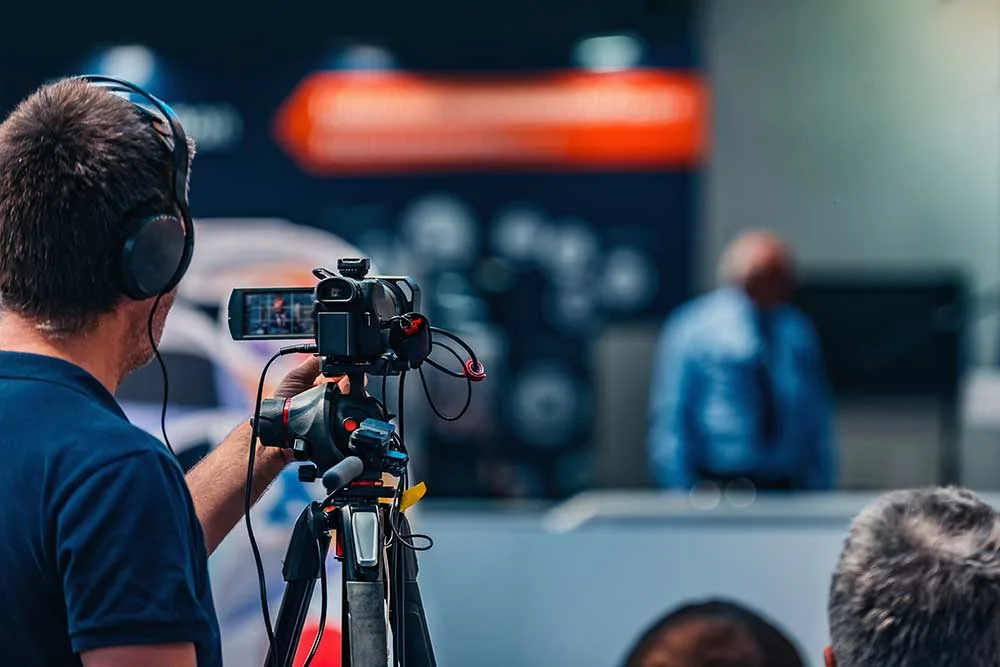
Your core equipment list includes broadcast-grade cameras, professional lighting rigs, audio capture systems, and an integrated control room setup. Centralised programmable control processors can execute complex macros that simultaneously power up projectors, activate PTZ cameras, and route signals across your studio network with a single command.
A modular set design lets you reconfigure the physical space quickly, so you can produce a news segment, a branded interview, and a product showcase all within the same studio footprint. Ceiling-to-floor friction-mounted poles give you flexible overhead mounting points for lights and cameras without permanent installation.
Core Studio Equipment
A professional studio setup is the backbone of any branded TV content operation.
The right gear boosts your production from amateur to broadcast-ready.
Here’s what every serious studio needs:
- Cameras and capture cards – Use mirrorless cameras with HDMI output or capture cards for sharp, clean video.
- Audio equipment – The Focusrite Scarlett 2i2 (4th gen) delivers reliable sound at £120–£240.
- Lighting systems – LED panels like the Neewer RGB 660 Pro provide soft, balanced illumination.
- Supporting infrastructure – UPS units, monitors, and standing desks stabilise daily operations.
You’re part of a community that values quality.
Each component works together to build a studio that consistently delivers professional results. For larger installations, professional video routing chassis can handle hundreds of SDI feeds simultaneously, making it practical to scale a master control room as content output grows. Streaming and recording workflows are further strengthened by pairing your setup with software like OBS Studio for scene management and live output control.
Modular Set Design
Once your core equipment is in place, your physical set becomes the next variable to control. Modular set design gives your television production the flexibility to reconfigure panels, desks, and platforms between interviews, keynotes, and panel discussions. You belong in that professional broadcast space, and modular systems make it achievable.
These sets ship pre-finished, install onsite, and move easily between locations. Modular MicroLED panels form bezel-less walls with high brightness and accurate colour output. Your brand’s logos, colour palettes, and messaging integrate directly into the set design. Hard, flat surfaces within a set environment also introduce reflected sound waves that increase reverberation time and reduce speech intelligibility in broadcast recordings.
Key modular advantages include:
- Reconfigurable layouts for multiple television formats
- Custom branding on stacked and connected panels
- Compact transport with high-impact onsite presence
- Future reconfiguration as your production needs evolve
FX Design Group, based in Orlando, Florida, specialises in broadcast set and lighting design that brings these modular environments to life for clients across the United States and internationally.
Build a Two-Speed Strategy for Short-Form and Long-Form TV Content
Branded content for television works best when you treat short-form and long-form as two engines running together, not competing formats. Long-form content builds depth and loyalty. Short-form content drives uncovering and reach. Running both together gives your brand complete coverage.
Here’s how to build your two-speed strategy:
- Batch-record long-form interviews, podcasts, or branded segments as your foundation content.
- Upload long-form footage to AI platforms like OpusClip for automatic short-form clip identification.
- Allocate budgets across linear television and streaming for balanced audience reach.
- Pair linear scale with streaming targeting to strengthen overall performance.
Half of surveyed brands already plan a balanced linear-streaming mix. This approach delivers transparency, efficiency, and consistent content output across every platform your audience uses. For productions requiring reliable signal delivery, working with a broadcast infrastructure supplier ensures your studio and transmission hardware are built for zero-failure live environments.
Get Your Branded Content in Front of the Right TV Audiences
Reaching the right TV audiences in 2026 means grasping where attention lives and how it behaves.
Viewers spend an average of nine minutes browsing home screens before selecting content. That’s nine minutes of high-attention exposure your brand can own.
Streaming audiences expect relevance. They tune out advertising that doesn’t match their interests, values, or experiences.
You’re not buying placements anymore—you’re comprehending behaviour.
AI-driven personalisation helps you target streaming campaigns with precision and professional audio gear guarantees your content sounds as sharp as it looks.
Poor audio kills engagement instantly.
Broadcast-level productions rely on 100-volt line amplifiers with step-up transformers to distribute audio across large venues without signal loss or volume degradation.
Key audience facts for 2026:
- 77% of advertisers are increasing TV budgets
- Streaming ad spend surpasses linear TV by 2027
- Personalisation and relevance drive measurable performance outcomes
Belong to the brands audiences actually trust.
Track Viewership, Engagement, and Brand Lift by Channel
Knowing your audience is one thing—knowing whether your content actually moved them is another.
CTV measures performance through unique device IDs and real-time viewership data.
Interactive CTV ads increase viewer time by 71 seconds—a great result for branded content.
Track your performance across these key areas:
- Viewership – Connected TV surpassed cable and broadcast combined by mid-2025.
- Engagement – Completion rates on CTV outperform linear TV consistently.
- Brand lift – Interactive CTV formats enhance brand recall by 36%.
- Cross-channel measurement – 64% of marketers connect CTV data to mobile engagement using first-party data.
Your broadcast equipment infrastructure directly affects signal quality and content delivery.
Reliable equipment means reliable data.
A professional video routing and switching setup at the master control room level ensures that every signal entering your broadcast chain is clean, consistent, and measurable from source to screen.