Most South African broadcasters spend more time vetting their on-air talent than their equipment suppliers—and that’s exactly how counterfeit decoders, regulatory seizures, and single-source supply failures quietly destroy operations.
Your supplier choice determines signal quality, long-term ROI, and whether your broadcast licence survives the next audit. The difference between a reliable partner and a catastrophic mistake isn’t always obvious from a catalogue or a price quote. What you need to know before signing anything could save your entire operation.
Why the Wrong Supplier Can Derail Your Broadcast Operation
Choosing the wrong broadcast equipment supplier puts your entire operation at risk. Poor-quality decoders cause signal interruptions. Incompatible hardware leads to widespread viewer blackouts.
The wrong broadcast equipment supplier doesn’t just cost money — it costs your entire operation.
Your community of broadcasters depends on reliable infrastructure. When you source from unvetted suppliers, you face:
- Synchronization failures between audio-visual systems
- Decoder malfunctions across multiple manufacturers
- Live transmission breakdowns during critical moments
Regulatory compliance adds another layer of risk. ICASA seized broadcast equipment from StarSat’s premises after its licence expired in July 2023. That single sourcing failure halted operations entirely and left workers facing an uncertain future.
Supply chain pressures affect 36 profiled companies across South Africa. Choosing proven broadcast equipment partners protects your schedule, your team, and your audience’s trust. Reputable suppliers support parallel-build strategies that allow broadcasters to maintain live services while upgrading critical infrastructure without interruption. StarSat’s legal team rushed to court in an attempt to challenge the seizure and retrieve equipment not affected by the licensing dispute.
How to Choose a Broadcast Equipment Supplier in South Africa
When your broadcast operation depends on uninterrupted transmission, the supplier you select determines whether you stay on air or go dark. Choosing the right partner means evaluating what matters most to your infrastructure.
Consider these key factors:
- Experience: Proven success in broadcast installations confirms technical capability
- Product range: all-encompassing lines covering audio, visual, and signal equipment reduce coordination complexity
- Reputation: Client references and industry recognition validate service quality
- Compatibility: Equipment must align with your existing software and technical specifications
- Support structure: Quick response times and on-site assistance keep operations running smoothly
You deserve a supplier who comprehends your environment. Prioritising these criteria connects you with partners who deliver reliable broadcast infrastructure, not just hardware. The right choice keeps your operation performing consistently. Suppliers who apply a zero-failure design principle understand that live television cannot buffer and live radio cannot drop audio, making reliability a non-negotiable foundation of every installation. Suppliers offering nationwide deployment capability ensure that equipment setup and technical support reach your locations across Johannesburg, Cape Town, and Durban without logistical gaps.
Top Broadcast Equipment Suppliers in South Africa
South Africa’s broadcast equipment market includes several well-established suppliers, each serving distinct segments of the industry. You’ll find options ranging from live event staging to full studio infrastructure. Knowing who specialises in what helps you make smarter purchasing decisions.
Each supplier serves a specific niche. Choosing the right one depends on your project’s technical requirements and budget. Audio Africa Broadcasting Services, established in Pretoria North in 2022, also operates as a focused B2B supplier offering broadcast technology integration across television, radio, corporate, and hospitality environments. Electrosonic SA also supplies trussing, staging, and rigging equipment, making them a strong option for live event and staging projects beyond standard broadcast needs.
Buying vs. Renting Broadcast Equipment in South Africa
Once you’ve identified the right broadcast equipment suppliers in South Africa, your next decision is whether to buy or rent the equipment you need.
Both options carry distinct financial and operational implications, and your choice depends on factors like budget, usage frequency, and long-term business goals. Grasping the benefits of each path helps you make a cost-effective, strategic decision for your broadcasting setup. For permanent studio installations, suppliers often provide complete hardware packages including server racks and UPS batteries to support long-term infrastructure needs.
Renting is often the more practical choice for one-time or infrequent projects, while purchasing tends to deliver greater value for operations that rely on frequent, regular use.
Buying Broadcast Equipment Benefits
Buying broadcast equipment outright gives your operation a strategic edge in South Africa’s competitive media environment. Ownership means you’re part of a community that controls its own infrastructure. You won’t face scheduling conflicts or third-party dependencies.
Owning professional audio gear and broadcast equipment delivers clear long-term advantages:
- Full customisation – Modify equipment to your exact specifications without restrictions.
- Immediate availability – Access gear anytime, including last-minute productions.
- Long-term savings – Daily rental rates reach 5–10% of purchase price, making ownership cost-effective for frequent use.
- No depreciation losses – You retain equity while avoiding obsolescence risks through strategic upgrades.
Ownership builds stability within your operation. You’re investing in infrastructure that supports consistent, professional output. For television and radio operations, this includes owning critical assets such as video switchers and transmitters that form the backbone of uninterrupted broadcast delivery. When renting, the provider typically handles insurance, repairs, and replacement costs, shifting those financial risks away from your business. That’s a great result for any serious broadcaster.
Benefits of Renting Broadcast Equipment
Renting broadcast equipment offers an attractive alternative when capital budgets are tight or production schedules are irregular. You pay only for the duration you need the equipment, eliminating storage, maintenance, and depreciation costs entirely.
Rental access gives you state-of-the-art equipment without long-term commitment. You can test new technologies before purchasing, ensuring your setup meets current industry standards. Rental companies maintain all equipment to peak operational standards, reducing failure risks during critical broadcasts.
Scalability is another great result of renting. You adjust equipment quantities based on your specific event requirements, scaling up or down on short notice. Professional rental support also simplifies your equipment selection process, providing tailored recommendations that match your venue specifications and broadcast goals. For large-scale productions such as annual general meetings or product launches, rental packages can include heavy-duty flight cases containing mobile control rooms with professional video routing, digital audio mixers, and wireless microphone receivers ready for immediate deployment.
Making the Right Choice
Both renting and buying broadcast equipment come with real advantages, and the right choice depends on your specific situation. Consider your budget, usage frequency, and long-term goals before deciding.
Ask yourself these key questions:
- Do you use equipment daily or only occasionally?
- Can your business handle a large upfront investment?
- Do you need full customisation and control?
- Are maintenance responsibilities something you can manage?
Frequent users benefit most from buying, whilst startups or one-time project teams often find renting smarter. Reliable suppliers offer flexible rental terms ranging from 12 to 36 months.
Ownership builds long-term value, but renting preserves cash flow during growth phases. Evaluate both options carefully to find what fits your operation best. For large-scale installations, suppliers using 100-volt line amplifiers can distribute audio across hundreds of speakers from a single amplifier without volume loss, making ownership a compelling long-term investment.
Building a Complete Broadcast Infrastructure From a Single Supplier
Managing multiple supplier relationships adds cost, complexity, and risk to any broadcast infrastructure project. Working with a single supplier simplifies procurement, reduces miscommunication, and keeps your project on schedule.
South African suppliers like Audio Africa offer consolidated solutions covering audio hardware, visual equipment, studio infrastructure, and transmission systems. You don’t need to coordinate between separate vendors for cameras, monitors, acoustic panels, and signal distribution equipment.
This integrated approach delivers measurable advantages:
- Unified technical support across all equipment categories
- Consistent compatibility between hardware systems
- Streamlined procurement and invoicing processes
- Reduced lead times through centralised stock management
Belonging to a professional broadcast community means accessing reliable infrastructure through trusted relationships. Audio Africa connects you to everything your operation needs, from studio builds to live event rollouts, through one accountable supplier. This includes the full acoustic lifecycle, from design calculations and material supply to installation of high-density acoustic foam panels that control internal reflections in professional broadcast environments.
What Full-Service Broadcast Supply Actually Looks Like in Practice
Consolidating your supplier relationships is one thing, but grasping what full-service broadcast supply actually delivers on the ground is another. You get end-to-end support, from initial design through installation, training, and maintenance. That’s a great result for any broadcast operation.
Here’s what full-service supply covers in practice:
- Design: Custom system blueprints, including virtual sets and IP workflow integration
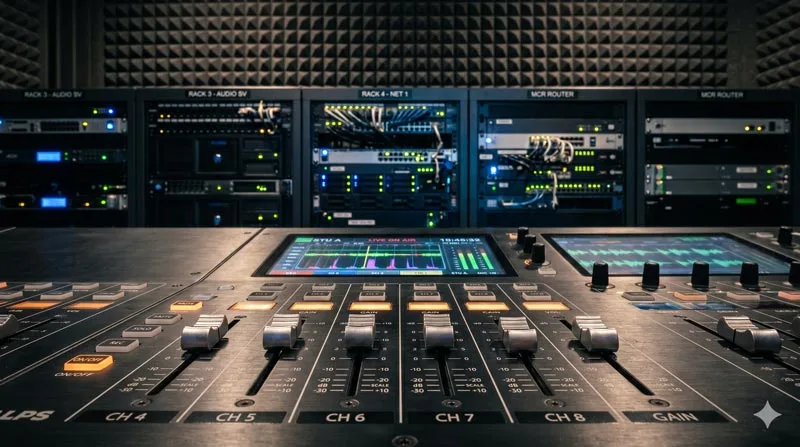
- Equipment: Hardware like audio mixing consoles, transmitters, and studio lighting
- Installation: On-site integration handled by experienced systems integrators
- Training: Post-implementation instruction covering equipment operation and maintenance
You’re not steering multiple vendors or chasing down support contracts. One supplier manages your entire infrastructure lifecycle. Audio Africa delivers this across Southern Africa, serving television networks, radio stations, and corporate clients from four regional offices.